
Chemotherapy-Induced Peripheral Neuropathy Market to Reach Nearly USD 3.8 Billion by 2036 | DelveInsight
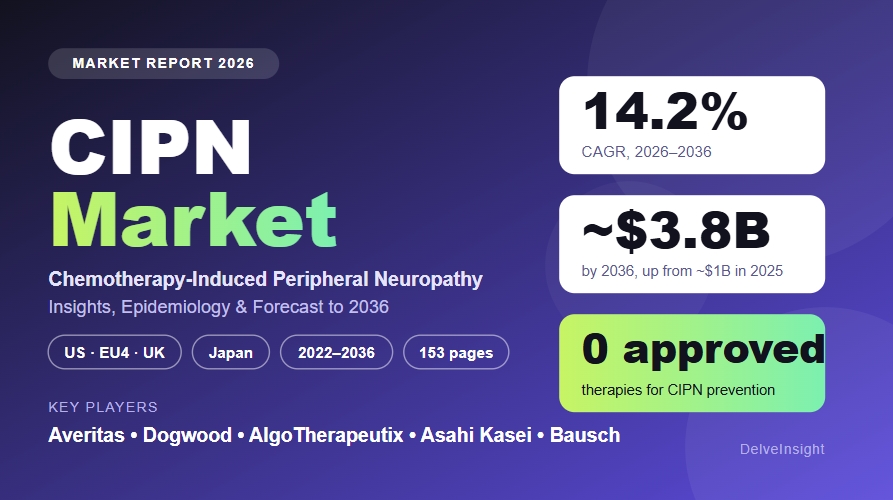
The Chemotherapy-Induced Peripheral Neuropathy Market report analyzes the current treatment landscape, standards of care and evolving therapeutic algorithms, as well as patient burden trends, revenue and market share dynamics, peak patient share and therapy uptake. It also highlights key unmet medical needs and maps the competitive and clinical landscape to uncover high-value opportunities.
Get a free sample of the CIPN Market Forecast
Key Facts from the Chemotherapy-Induced Peripheral Neuropathy Market Report
-
The CIPN market in the 7MM was valued at approximately USD 1.0 billion in 2025 and is projected to reach nearly USD 3.8 billion by 2036, at a CAGR of 14.2% (2026–2036).
-
The United States was the largest market in 2025, at approximately USD 535 million. In 2036, capsaicin 8% (QUTENZA) is expected to generate the highest revenue among emerging CIPN treatment therapies in the US.
-
The 7MM had approximately 1.6 million incident CIPN cases in 2025.
-
CIPN affects up to 90% of patients treated with neurotoxic chemotherapy, and many experience persistent, debilitating symptoms.
-
No therapies are FDA-approved for CIPN prevention, and treatment options are limited. Duloxetine is the only agent supported by moderate evidence.
-
Emerging treatments include capsaicin 8% (QUTENZA) by Averitas Pharma (Grünenthal), Halneuron (tetrodotoxin) by Dogwood Therapeutics and ATX01 (amitriptyline hydrochloride 15%) by AlgoTherapeutix.
-
Preventive candidates include Recomodulin (ART-123) by Asahi Kasei Pharma, Tarian Gel (TAR-0520) by Tarian Pharma and pirenzepine (WST-057) by WinSanTor.
-
July 2026: The first patient was dosed in a clinical trial of a novel candidate designed to treat CIPN, aiming to address the unmet need of cancer patients with severe nerve pain and tingling.
-
February 2026: Dogwood Therapeutics announced it had passed 50% of planned enrollment in its Phase IIb HALT-CINP trial of Halneuron in chemotherapy-induced neuropathic pain.
-
December 2025: Dogwood reported positive interim results from 97 patients in the Phase IIb study. An independent statistical review of unblinded data showed a clear improvement in pain with Halneuron versus placebo over four weeks.
-
June 2025: The European Patent Office granted an EU patent (licensed from Yale University) for OSM-0205. Osmol is securing financing to begin a Phase I trial.
To know more about the CIPN market outlook, drug uptake, treatment scenario and epidemiology trends, click here: https://www.delveinsight.com/report-store/cipn-market
Chemotherapy-Induced Peripheral Neuropathy Overview
CIPN is a common and clinically significant toxicity of agents such as platinum compounds, taxanes, vinca alkaloids and proteasome inhibitors, which are widely used in breast, colorectal and prostate cancers and hematological malignancies. The resulting nerve damage causes persistent sensory symptoms such as tingling, numbness and burning pain, often in a “glove and stocking” distribution. Symptoms can last for months or years, impair quality of life, contribute to psychological distress and, in severe cases, force chemotherapy dose reduction or discontinuation.
Chemotherapy-Induced Peripheral Neuropathy Diagnosis
There is no standardized method for diagnosing CIPN. Assessment relies on clinical evaluation, including patient history, symptoms, neurological examination and chemotherapy exposure. Tools include nerve conduction studies, quantitative sensory testing, clinician-graded scales (e.g., NCI-CTCAE) and patient-reported measures (e.g., EORTC QLQ-CIPN20). Emerging biomarkers such as neurofilament light chain (NfL), microRNAs and ABCB1 variants show potential for early detection but remain under validation.
Chemotherapy-Induced Peripheral Neuropathy Treatment Landscape
No agents are currently recommended for CIPN prevention, and management mainly involves chemotherapy dose reduction, delay or discontinuation. Exercise, acupuncture, mindfulness and massage may help relieve symptoms. Among drugs, duloxetine has moderate evidence for pain relief and venlafaxine may help in select cases. Amitriptyline shows inconsistent efficacy, gabapentin and pregabalin have largely failed to show significant benefit, and topical lidocaine and capsaicin patches show promise for localized pain. Opioids are third-line options because of limited efficacy and risks.
Discover the current and emerging Chemotherapy-Induced Peripheral Neuropathy treatment landscape
Chemotherapy-Induced Peripheral Neuropathy Epidemiology Highlights
-
The 7MM had approximately 1.6 million incident CIPN cases in 2025.
-
In the US in 2025, severe CIPN accounted for the most cases (approximately 239,600), followed by mild (approximately 208,550) and moderate (approximately 199,500).
-
In the EU4 and the UK, breast cancer (approximately 123,450 CIPN cases) and colorectal cancer (approximately 118,600) made up the majority of CIPN incidence in 2025.
-
CIPN risk depends strongly on the extent of chemotherapy use, with higher utilization in hematologic, lung and gastric cancers, so risk rises with treatment intensity and duration.
The epidemiology chapter covers the total incident population, severity-specific incidence, incidence by cancer type and the total treated population.
Download the report to understand which factors are driving Chemotherapy-Induced Peripheral Neuropathy epidemiology trends
Chemotherapy-Induced Peripheral Neuropathy Emerging Therapies
Capsaicin 8% (QUTENZA) – Averitas Pharma (Grünenthal): A high-dose topical patch targeting TRPV1-expressing nociceptors to provide sustained relief from neuropathic pain without systemic exposure. It is in the Phase III ACT trial for CIPN, with primary completion estimated for March 2028 and a potential US launch in 2029.
Halneuron (tetrodotoxin) – Dogwood Therapeutics: A subcutaneous NaV1.7 inhibitor in Phase II for CIPN.
ATX01 (amitriptyline hydrochloride 15%) – AlgoTherapeutix: A topical inhibitor of nociceptive voltage-gated sodium channels (Nav1.7, Nav1.8 and Nav1.9), in Phase II.
Recomodulin (ART-123) – Asahi Kasei Pharma: An intravenous recombinant thrombomodulin in Phase III for CIPN prevention. Its entry is expected to intensify competition in the prevention landscape in the latter half of the forecast period.
Other pipeline programs include Tarian Gel (TAR-0520), pirenzepine (WST-057), SNT-001/TRK-7501 (Sanodyne/Toray), SON-080 (Sonnet BioTherapeutics) and VMD-3866 (VM Therapeutics).
Learn more about the companies and therapies set to grab major Chemotherapy-Induced Peripheral Neuropathy market share
Chemotherapy-Induced Peripheral Neuropathy Market Recent Developments
-
July 2026: The first patient was dosed in a clinical trial of a novel candidate designed to treat CIPN, aiming to address the unmet need of cancer patients with severe nerve pain and tingling.
-
February 2026: Dogwood Therapeutics announced it had passed 50% of planned enrollment in its Phase IIb HALT-CINP trial of Halneuron in chemotherapy-induced neuropathic pain.
-
December 2025: Dogwood reported positive interim results from 97 patients in the Phase IIb study. An independent statistical review of unblinded data showed a clear improvement in pain with Halneuron versus placebo over four weeks.
-
June 2025: The European Patent Office granted an EU patent (licensed from Yale University) for OSM-0205. Osmol is securing financing to begin a Phase I trial.
Chemotherapy-Induced Peripheral Neuropathy Market Unmet Needs
-
Lack of FDA-approved therapies
-
Insufficient evidence and no clinical guidelines for CIPN prevention
-
Biological complexity that hinders targeted therapeutics
-
Reversal of “coasting” and long-term chronic neuropathy
Chemotherapy-Induced Peripheral Neuropathy Market Outlook
Current CIPN treatment is largely symptomatic. Antidepressants, anticonvulsants and opioids show modest, inconsistent efficacy and are often limited by systemic side effects. Duloxetine is the only guideline-recommended first-line therapy, yet its real-world use is frequently delayed by step-therapy requirements. The market is expected to evolve with rising chemotherapy use, growing disease awareness and advances in targeted, mechanism-based therapies for both treatment and prevention. Topical and small-molecule approaches currently dominate, while novel systemic and preventive strategies are expected to drive future diversification.
Chemotherapy-Induced Peripheral Neuropathy Market Access, Reimbursement and Pricing
Reimbursement is a crucial factor in market access, and payers are considering a range of payment models to reduce the burden of high-cost therapies. The report also covers country-wise accessibility, cost-effectiveness, and pricing and analogue assessment of CIPN therapies.
Scope of the Chemotherapy-Induced Peripheral Neuropathy Market Report
-
Study period: 2022–2036 (historical 2022–2025; forecast 2026–2036; base year 2026)
-
Geographies: US, EU4 (Germany, France, Italy, Spain), UK and Japan
-
Segmentation: by region and by therapy
-
Analysis: addressable patient population, market drivers and barriers, cost assumptions and pricing analogues, KOL views, SWOT, reimbursement, conjoint analysis and unmet needs
-
Methodology: epidemiology-based, bottom-up forecasting; AI-enabled report with 11-year forecast
Reasons to Buy Chemotherapy-Induced Peripheral Neuropathy Market Report
-
Understand the latest trends and treatment dynamics to develop business strategies.
-
Gain patient-burden insights and a bottom-up forecast built from the affected population.
-
Identify strong upcoming players and growth potential by geography.
-
Evaluate current and emerging therapies through conjoint analysis.
-
Understand KOL perspectives on accessibility, acceptability and compliance, and the unmet needs shaping development and launch strategy.
About DelveInsight
DelveInsight is a leading healthcare business consultant and market research firm focused exclusively on life sciences. It supports pharma companies with comprehensive end-to-end solutions to improve their performance, and offers healthcare consulting services that help accelerate business growth and overcome challenges with a practical approach.
Media Contact
Company Name: DelveInsight Business Research LLP
Contact Person: Mehul Malhotra
Email: Send Email
Phone: 09650213330
Address:A-1 NV 89107
City: delhi
State: Indiana
Country: United States
Website: https://www.delveinsight.com/consulting


