
Virtual Clinical Trials Market to Reach USD 13.56 Billion by 2031 as Decentralized Models and Digital Trial Platforms Gain Adoption
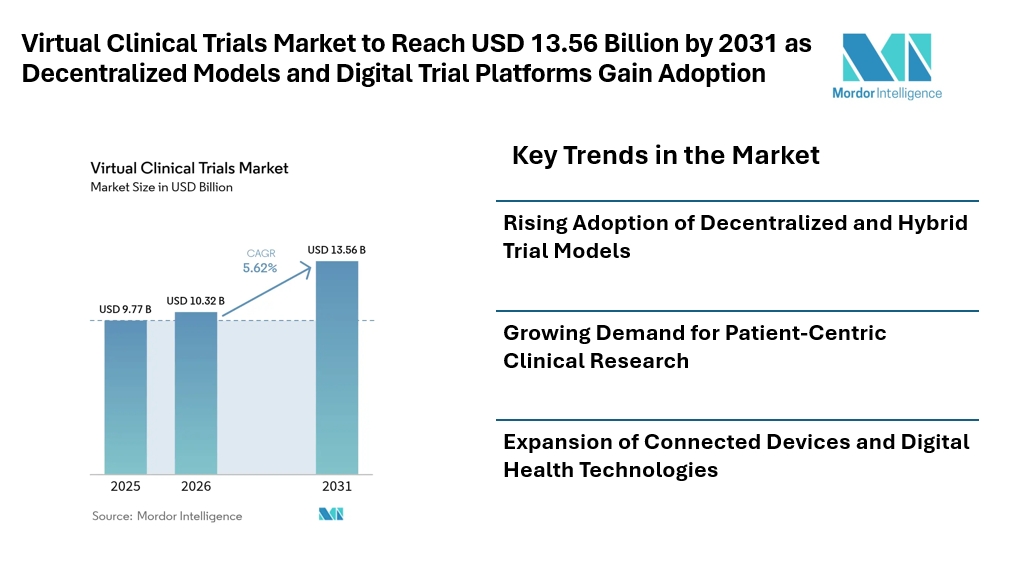
Hyderabad, India – 8 October 2026 – According to Mordor Intelligence, the Virtual Clinical Trials Market size is estimated at USD 10.32 billion in 2026 and is expected to reach USD 13.56 billion by 2031, registering a CAGR of 5.62% during the forecast period. North America currently holds the largest market share, while Asia-Pacific is projected to register the fastest growth.
The Virtual Clinical Trials Market covers technology and service revenue used to conduct clinical studies in which major trial activities take place remotely, including patient identification, electronic consent, data collection, and remote monitoring. The market is gaining traction as sponsors seek alternatives to costly site-based trials and as regulators increasingly recognize decentralized and hybrid trial models. Growing connectivity, consumer health devices, patient-centric trial designs, and investment in digital trial platforms are further supporting market expansion.
Report Overview: https://www.mordorintelligence.com/industry-reports/virtual-clinical-trials-market?utm_source=abnewswire
Virtual Clinical Trials Market Trends
Rising Adoption of Decentralized and Hybrid Trial Models
The increasing cost and operational complexity of traditional site-based clinical trials are encouraging pharmaceutical companies and research organizations to incorporate remote activities into study protocols. Virtual and hybrid approaches can reduce dependence on physical trial sites while allowing sponsors to reach patients who may face transportation, geographic, or scheduling barriers.
Regulatory acceptance is also strengthening the business case for decentralized models. The FDA’s guidance on decentralized clinical trials and the adoption of ICH E6(R3) have provided greater clarity around activities such as telehealth visits, local laboratory services, and remote data acquisition. These developments are helping sponsors treat virtual approaches as an established trial option rather than a temporary response to operational disruptions.
Growing Demand for Patient-Centric Clinical Research
Patient convenience is becoming an important consideration in clinical-trial design. Remote consent, home-based assessments, electronic patient-reported outcomes, and decentralized monitoring can reduce the need for repeated visits to research sites and make participation more practical for patients with chronic or mobility-limiting conditions.
Virtual approaches can also support broader geographic participation and improve access to underrepresented patient groups. This is particularly relevant for studies involving rare diseases, oncology, neurology, and other conditions where recruiting suitable participants across multiple locations can be challenging.
Expansion of Connected Devices and Digital Health Technologies
The increasing availability of smartphones, wearable devices, connected sensors, and remote-monitoring technologies is expanding the range of data that can be collected outside traditional clinical settings. Continuous physiological measurements can complement conventional clinical assessments and provide sponsors with more frequent information during a study.
Cloud platforms are also gaining importance as sponsors manage larger volumes of data from distributed participants. Integration between digital health technologies, electronic clinical outcome assessments, data-capture systems, and analytics platforms is supporting more connected virtual trial workflows.
Increasing Use of Digital Platforms and Trial Services
Software platforms represent a major component of the Virtual Clinical Trials industry, supporting functions such as electronic consent, patient engagement, randomization, data capture, remote assessments, and trial monitoring. Sponsors are increasingly seeking integrated platforms that can connect multiple trial activities instead of relying on fragmented technology systems.
Services are also gaining importance as pharmaceutical companies and biotechnology firms seek external expertise for decentralized trial design, participant recruitment, logistics, regulatory support, and study execution. This is creating opportunities for CROs and specialized technology providers to offer combined technology and operational services.
Cybersecurity and Regulatory Complexity Remain Challenges
The expansion of remote data collection increases the number of digital endpoints and connected systems involved in clinical research. Data privacy, cybersecurity, consent management, and secure transfer of sensitive clinical information therefore remain important considerations for sponsors and technology providers.
Regulatory and ethics requirements can also vary across countries, creating additional complexity for multinational decentralized studies. Differences in remote-consent procedures, data residency requirements, monitoring expectations, and local ethics review can increase the operational burden associated with virtual clinical trials.
Virtual Clinical Trials Market Segmentation
By Study Design
-
Interventional
-
Observational
-
Expanded Access
Interventional studies currently represent the largest segment, while observational studies are gaining momentum as sponsors increase their use of real-world evidence and longitudinal data collection.
By Phase
-
Phase I
-
Phase II
-
Phase III
-
Phase IV
Phase III represents the leading segment because large patient populations and extended follow-up requirements create strong opportunities for remote engagement. Early-phase studies are also increasingly incorporating virtual tools for selected assessments and patient monitoring.
By Component
-
Software Platforms
-
Services
Software platforms account for the larger share of the market, supporting digital trial management, data capture, patient engagement, and remote assessments. Services are gaining importance as sponsors outsource trial design, logistics, regulatory activities, and decentralized study execution.
By Delivery Mode
-
Web-Based
-
Cloud-Based
-
On-Premise
Web-based solutions currently represent the leading delivery mode, while cloud-based platforms are expanding as sponsors require scalable storage, real-time analytics, and access to distributed clinical data.
By End User
-
Pharmaceutical & Biopharma Companies
-
Medical-Device Manufacturers
-
Contract Research Organizations
-
Academic & Research Institutes
Pharmaceutical and biopharmaceutical companies represent the largest end-user segment. Medical-device manufacturers and CROs are also increasing their use of decentralized approaches as connected devices and digital endpoints become more common in clinical research.
By Indication
-
Oncology
-
Cardiovascular Diseases
-
Neurology
-
Endocrine & Metabolic
-
Rare-Disease / Orphan
-
Other Indications
Oncology accounts for the largest share, supported by the need to reduce patient travel and improve monitoring during intensive treatment programs. Neurology is emerging as an important growth area because digital biomarkers and remote assessments can capture cognitive and motor outcomes outside conventional clinical settings.
By Geography
-
North America: United States, Canada, and Mexico
-
Europe: Germany, United Kingdom, France, Italy, Spain, and Rest of Europe
-
Asia-Pacific: China, Japan, India, Australia, South Korea, and Rest of Asia-Pacific
-
Middle East & Africa: GCC, South Africa, and Rest of Middle East & Africa
-
South America: Brazil, Argentina, and Rest of South America
North America currently represents the largest regional market, supported by regulatory clarity, established digital infrastructure, and strong participation from pharmaceutical companies, CROs, and technology providers. Asia-Pacific is expected to record the fastest growth as connectivity improves and decentralized clinical research capabilities expand.
Virtual Clinical Trials Market Competitive Landscape
The Virtual Clinical Trials Market share is moderately concentrated, with competition spanning large CROs, clinical-trial technology companies, and specialized digital platforms. Companies are competing through integrated trial-management solutions, remote patient engagement, data analytics, decentralized study services, and artificial intelligence-enabled workflows.
Key Players
-
IQVIA Inc.
-
ICON plc
-
Parexel International Corp.
-
Labcorp (Covance)
-
Oracle Health Sciences
-
Medable Inc.
-
Dassault Systèmes (Medidata)
-
Signant Health
-
Science 37 Inc.
-
THREAD Research
-
Syneos Health
-
WuXi AppTec
-
Novotech CRO
-
ObvioHealth
-
YPrime
-
Castor EDC
-
Veeva Systems
-
Alira Health
-
ClinOne
-
Medpace Holdings Inc.
Leading companies are expanding their capabilities through AI-enabled trial execution, remote patient engagement, data integration, decentralized trial services, and specialized solutions for therapeutic areas such as oncology, neurology, and rare diseases.
For more insights on the Japanese market report, please visit the Mordor Intelligence page: https://www.mordorintelligence.com/ja/industry-reports/virtual-clinical-trials-market?utm_source=abnewswire
Conclusion
The Virtual Clinical Trials Market forecast points to continued expansion as pharmaceutical and biotechnology companies increasingly incorporate decentralized activities into clinical research. Regulatory acceptance, rising trial costs, patient demand for greater convenience, and broader availability of connected health technologies are supporting the transition toward hybrid and virtual study models.
North America is expected to retain its leading position because of its established regulatory framework, digital infrastructure, and strong concentration of pharmaceutical, CRO, and clinical-technology companies. Asia-Pacific is projected to experience the fastest growth as connectivity improves, clinical research capacity expands, and sponsors seek broader patient access across the region.
About Mordor Intelligence
Mordor Intelligence is a global market intelligence firm, founded in 2014, helping businesses make informed decisions through data-driven insights, industry expertise, and advanced analytics. With 550+ domain experts and on-ground specialists across 150+ countries, the company delivers comprehensive intelligence across aerospace & defense, agriculture, automation, automotive, chemicals & materials, consumer goods & services, electronics, energy & power, financial services, food & beverages, healthcare, hospitality & tourism, information & communications technology, and logistics.
Its offerings include syndicated industry reports and subscription platforms such as Synapse. Mordor Intelligence is ISO 9001:2015 and ISO/IEC 27001:2022 certified, a member of ESOMAR and the Market Research Society of India, and a four-time Great Place to Work® honoree. Learn more at mordorintelligence.com.
Media Contact
Company Name: Mordor Intelligence Private Limited
Contact Person: Jignesh Thakkar
Email: Send Email
Phone: +1 617-765-2493
Address:11th Floor, Rajapushpa Summit, Nanakramguda Rd, Financial District, Gachibowli
City: Hyderabad
State: Telangana 500008
Country: India
Website: https://www.mordorintelligence.com/


